
Why Do Students Forget Maths So Quickly? How Spaced Practice Builds Learning That Lasts
Why do students forget maths so quickly? Discover how spaced practice helps students retain and apply their learning long after the lesson ends.

Does this scenario sound familiar? Students come in, you deliver your lesson, the students complete questions and demonstrate understanding and appear ready to move on.
Then, a week later, they're faced with a similar problem and suddenly can't remember where to start.
It's a familiar experience for many maths teachers, so why does it happen? The answer usually isn't that students didn't understand the concept the first time. More often, it means they simply haven't had enough opportunities to revisit and retrieve that learning.
That's where spaced practice comes in.
What is spaced practice?
Spaced practice is the process of revisiting previously taught concepts over carefully planned intervals, rather than practising everything in one sitting.
Instead of teaching a topic, completing a worksheet and moving on, students return to key ideas multiple times over days or weeks. Each revisit strengthens their ability to retrieve the knowledge, helping move learning from short-term memory into long-term understanding.
In mathematics, where every new concept builds on previous knowledge, this can make a significant difference.
Why does it matter?
Mathematics is cumulative.
Students solving simultaneous equations rely on algebraic manipulation. Working with trigonometry depends on a solid understanding of ratios. Even more advanced topics often require fluency with skills taught months or years earlier.
When those foundational concepts haven't been revisited, students aren't just learning something new, they're trying to learn it while also remembering something old.
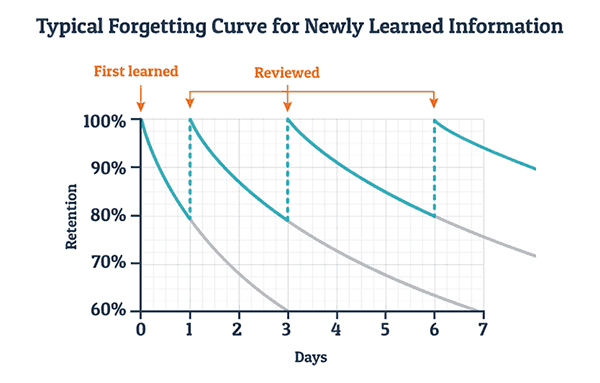
This is the forgetting curve in action: without review, retention of newly learned information drops away sharply within days. But each time a concept is revisited, the rate of forgetting slows and retention holds at a higher level for longer, until knowledge eventually becomes durable, long-term understanding.
Regular retrieval helps reduce those gaps before they become barriers to future learning, and the scale of the problem is well documented. Oxford University Press's Knowledge and Skills Gap Report 2021 surveyed 164 Australian secondary maths teachers and found that almost 94% had observed a knowledge and skills gap in students following the transition from primary to secondary school, with teachers reporting the widest gaps in Years 7–9. Nearly all of those teachers believed the gaps identified in Year 7 would have consequences for students' longer-term learning, and 86% said reduced confidence and increased anxiety were among the biggest flow-on effects.
The report doesn't prescribe a fix, but the pattern it describes, small gaps left unaddressed until they snowball into years-wide spreads of ability, is exactly what spaced, cumulative retrieval is designed to interrupt. By building review into everyday teaching rather than waiting for gaps to surface as barriers, teachers get more chances to catch and close them early.
Spaced practice isn't about doing more work
One of the biggest misconceptions about spaced practice is that it means adding extra lessons or assigning more homework.
In reality, it's about making small, intentional adjustments to the way practice is structured.
Rather than asking students to complete 30 questions immediately after learning a concept, teachers might revisit just a few carefully selected questions a week later, then again several weeks after that.
These short moments of retrieval encourage students to actively recall their learning instead of simply recognising a familiar process.
Over time, those retrieval opportunities build confidence, fluency and long-term retention.
What does effective spaced practice look like?
Successful spaced practice gradually reduces the amount of support students receive while increasing the amount of independent retrieval.
A simple approach might look like this:
Build understanding. When students first encounter a new concept, they benefit from explicit instruction, worked examples and opportunities to practise with guidance. The goal is to develop understanding while building confidence.
Revisit the learning. After some time has passed, revisit the same concept using similar but not identical questions. At this stage, students should do more of the thinking themselves, allowing teachers to identify what has been retained and where further support is needed.
Strengthen and extend. As students become more confident, revisit the concept again through independent problem solving, mixed review or engaging classroom activities that require students to apply their knowledge in different contexts.
Each revisit strengthens retrieval and helps make learning more durable.
Supporting every learner
Every classroom contains students working at different levels of confidence and understanding.
Spaced practice doesn't mean every student completes exactly the same review task. Instead, teachers can adjust the level of support while keeping the learning goal consistent.
Some students may benefit from worked examples, hints or scaffolded questions when revisiting a concept. Others may be ready to tackle more challenging applications or extension problems.
The important thing is that every student has an opportunity to retrieve previously learned knowledge at an appropriate level of challenge.
Small changes can have a big impact
One of the strengths of spaced practice is that it doesn't require teachers to redesign an entire program.
Simple routines can make a meaningful difference, such as:
- beginning each lesson with two or three retrieval questions from previous topics
- revisiting earlier concepts during independent practice
- including cumulative review questions in assessments
- scheduling regular low-stakes review activities throughout a unit.
These small habits help students see mathematics as connected learning rather than isolated topics.
Building learning that lasts
It's easy to assume students have mastered a concept because they can complete questions immediately after it has been taught.
The real measure of learning is whether students can still retrieve and apply that knowledge weeks or months later.
Spaced practice shifts the focus from short-term performance to long-term understanding. It gives students repeated opportunities to strengthen their knowledge while giving teachers valuable insight into what has truly been learned.
See spaced practice in action
Understanding the principles of spaced practice is one thing. Knowing how to implement them consistently in a busy maths classroom is another.
That's exactly what we'll be exploring in our upcoming free webinar.
Join us as Adrian shares practical strategies for embedding spaced practice into everyday mathematics teaching, including simple approaches you can begin using immediately to strengthen student retention and build more durable mathematical understanding.
Whether you're looking to improve student confidence, strengthen long-term retention or make review more purposeful, this session will provide practical ideas you can take straight back to your classroom.